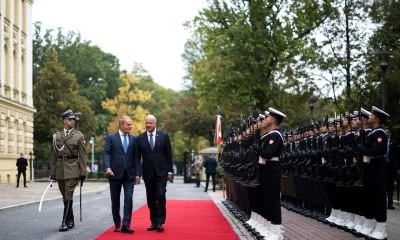
Historic Austria Poland talks recently cemented enhanced economic and security cooperation between the two nations. Austrian Chancellor Christian Stocker made his inaugural visit to the Polish capital, a first for an Austrian chancellor in nearly two decades. His discussions with Polish Prime Minister Donald Tusk centered on European security, migration policy, and the ongoing challenges from Russia’s war in Ukraine.
This high-level working visit carried significant symbolic and geopolitical weight. Prime Minister Tusk underscored the historical parallel of September 17, 1939, when the Red Army attacked Poland. He stressed the importance of learning from history, especially in light of current events. Tusk also reported a massive Russian attack near the Polish border in western Ukraine, which had prompted Polish fighter jet alerts just before their meeting.
Chancellor Stocker affirmed Austria’s full solidarity with its neighboring country. He declared that Russian attempts to destabilize EU member states must not succeed. Moreover, even as a militarily neutral state, Austria vowed to bolster European resilience.
The two leaders agreed to progressively intensify their economic relationship. A bilateral economic conference, co-chaired by their respective economy ministers, will now convene every two years. Furthermore, Chancellor Stocker announced a major project to drastically improve connectivity.
Austria plans to invest approximately €1 billion into expanding the Nordbahn railway line. This ambitious project aims to halve the train journey between Vienna and Warsaw, from eight hours to four, in the long term. Poland, with one of Europe’s fastest-growing economies, presents significant opportunities.
Chancellor Stocker’s delegation included a high-level business group. Among them was Peter Bosek, CEO of Erste Group. The banking giant is rapidly expanding its Central European footprint and toured Erste Bank Polska’s headquarters with the chancellor.
Regarding migration policy, Stocker and Tusk called for a unified EU-level approach. Stocker highlighted that external border protection is a collective responsibility, not solely national. He noted Poland’s crucial role as a border state and host to Frontex, the EU border protection agency. Both leaders advocated for strict return policies for individuals required to leave the EU. Austria also pushes for establishing return centers and asylum procedures in third countries. Stocker supported allowing member states to temporarily suspend asylum applications during exceptional border crises, citing examples like Ceuta. Prime Minister Tusk emphasized Poland’s “Eastern Shield” (Tarcza Wschód) border fortification project, which secures the entire continent. He made it clear that decisions impacting eastern flank security must involve Poland.
Economically, Chancellor Stocker urged EU-level reforms to boost competitiveness. He argued for a united and innovative Europe that reduces bureaucracy and ensures affordable energy. Stocker reiterated his criticism of the European electricity market’s merit-order system, which he believes disadvantages countries with high renewable energy shares. Meanwhile, Tusk addressed the upcoming EU financial framework negotiations. He acknowledged Austria as a net contributor and Poland as a significant recipient, but stressed that investments in the single market and border security benefit all members. Stocker again prioritized security issues in budget discussions. In closing, the Austrian Chancellor extended an invitation to Prime Minister Tusk for an official return visit to Vienna.