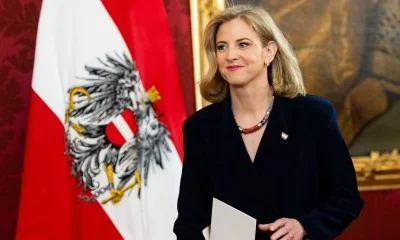
The Austrian federal government has unveiled plans to establish a specialized facility. This new “Center of Excellence Against Foreign Information Manipulation” will directly combat foreign disinformation and manipulation attempts. Foreign Minister Beate Meinl-Reisinger (NEOS) announced the initiative in the Bundesrat.
The center is scheduled to launch in spring 2027. An international conference in Vienna will mark its inauguration. This strategic move follows Meinl-Reisinger’s visit to Finland’s “European Center of Excellence for Countering Hybrid Threats” (Hybrid CoE) in Helsinki last August. That facility, founded in 2017, analyzes hybrid threats continuously. It includes Austria among its 35 partner countries since 2018.
Meinl-Reisinger highlighted growing “global disorder” in her speech. She noted Russia’s war in Ukraine now significantly impacts Central Europe. A “shadow war” affects both Europe and Austria, she warned. For instance, past cyberattacks by Russian groups targeted the Ministry of Foreign Affairs and the Carinthian provincial administration. Therefore, the government plans to boost media literacy and safeguard state institutions to counter foreign influence.
However, these plans received a mixed reception within the Federal Council. They sparked a broader debate on Austria’s security and foreign policy. People’s Party representatives stressed the need for strong European collaboration. Günther Ruprecht (ÖVP) affirmed that neutrality does not imply passivity in the face of international law violations. He also called for active engagement in the Western Balkans to ensure regional stability.
Social Democrats, meanwhile, advocated for a wider security definition. Claudia Arpa (SPÖ) pointed out foreign policy’s direct impact on citizens’ finances, citing energy prices. Dominik Reisinger (SPÖ) demanded clear inclusion of hybrid threats in the new security strategy. By contrast, the Freedom Party strongly criticized the proposals. Peter Samt and Sandra Jäckel (FPÖ) championed permanent neutrality as Austria’s “shield.” They warned against integration into NATO or EU military structures. Furthermore, FPÖ lawmakers viewed the anti-disinformation plans skeptically, fearing a potential “censorship tool against dissenters.”
NEOS and the Greens, however, welcomed the government’s direction. They also applauded Austria’s upcoming role as a non-permanent member of the UN Security Council. Julia Deutsch (NEOS) emphasized Austria’s inability to remain disengaged from global conflicts. Elisabeth Kittl (Greens) called for action against autonomous weapon systems and disinformation. Moreover, she advocated for greater integration of climate policy into the global security agenda.
The Finnish Hybrid CoE operates as a crucial network hub. It brings together civilian and military experts. Its global network includes over 3,000 professional and academic contacts. The center focuses on three key areas: Hybrid Influence (information manipulation and covert operations), Strategy and Defense (hybrid warfare and security policies), and Vulnerabilities and Resilience (identifying weaknesses and strengthening societal resistance). To combat foreign disinformation and other threats, it analyzes threats, publishes reports, conducts crisis exercises, and offers specialized training. This center serves as a vital platform for EU and NATO members to exchange information and strategies.
The planned Austrian center would integrate expertise from IT, intelligence services, military, and government. It would detect and repel attacks proactively. Its network with 35 partner countries, the EU, and NATO would provide access to confidential analyses and threat assessments. Through simulations, Austrian authorities could practice responses to real-world crises. These include coordinated disinformation waves before elections or simultaneous power grid hacks. The center aims to defend against threats and also enhance public resilience through media literacy.
Critics remain concerned, however. They fear a state-run center might define “truth” and stigmatize dissenting opinions. Due to the Finnish model’s close ties with NATO, neutrality advocates worry about deeper entanglement in Western military alliances. While hybrid threats do not constitute traditional military attacks, active measures against foreign actors could make Austria a larger target for countermeasures.